Shazam uses artificial intelligence to identify potentially productive, unproduced oil and gas accumulations in existing wells. Developed by Earth Science Associates (ESA), it analyzes millions of feet of Gulf of Mexico well logs, estimates potential recoverable volumes, and helps users evaluate opportunities in their geological and commercial context.
Approximately 98% of logged intervals in Gulf of Mexico wells lie outside completed zones. Shazam helps geologists, petrophysicists, and E&P companies screen this vast dataset for overlooked potential.
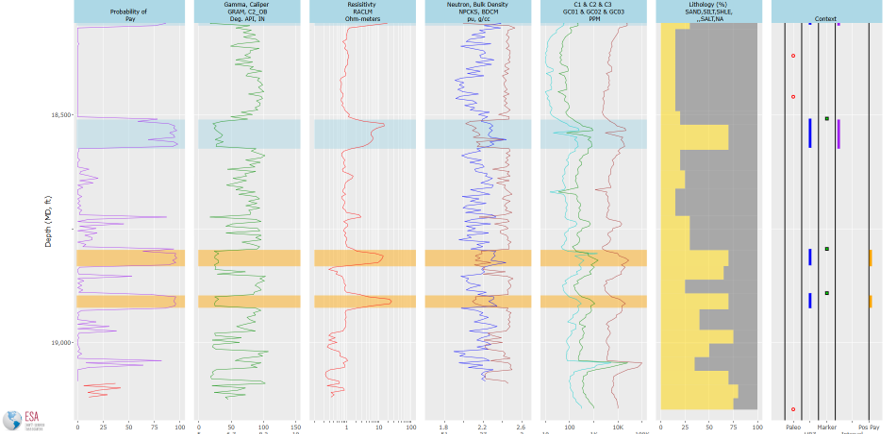
Figure 1. Two potential pays (orange) in a Miocene zone below an existing completion (blue).
How Shazam Works
Shazam combines Multilayer Perceptron (MLP) neural networks, Transformer models, and ensemble modeling to recognize well-log signatures associated with productive reservoirs.
Three levels of analysis accommodate different amounts of available data. The simplest uses depth, gamma ray, and resistivity; more detailed models add neutron porosity, bulk density, methane (C1), ethane (C2), propane (C3), and lithology. The Transformer analysis also incorporates geographic location, reservoir age, and salt.
For each one-foot interval, Shazam assigns a Probability of Pay score from 0% to 100%, indicating how closely it resembles productive reservoirs. Candidate pays must have at least ten continuous feet above model-specific thresholds. Models with fewer log curves use more conservative thresholds to account for greater uncertainty.
Estimating Recoverable Volumes
For each candidate, Shazam calculates a risked Estimated Ultimate Recovery (EUR) using at least 15 nearby analogous producing completions in the same stratigraphic interval. The estimate accounts for:
Cumulative oil and gas production and estimated remaining reserves
Productive completion thickness
Distance from the candidate, with closer analogs weighted more heavily
Model uncertainty and risk adjustments
These estimates help users compare opportunities across fields, lease portfolios, and the Gulf. They are screening-level assessments, not independently verified reserves, and require further geological, engineering, and economic evaluation.
Opportunities Across the Gulf of Mexico
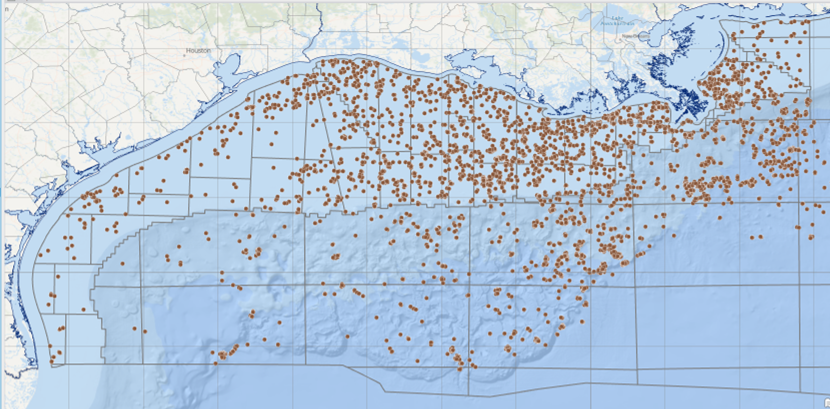
Shazam has analyzed more than 5,500 Gulf of Mexico wells and identified hundreds of potentially productive intervals. Many are small, but scores of candidates have risked EURs above one million barrels of oil equivalent (BOE), with some estimates reaching tens of millions of BOE.
Some candidates lie near existing infrastructure, which may reduce development costs. Others occur in abandoned wells or on relinquished leases, offering potential for renewed exploration and redevelopment.
Figure 2. Risked EUR in BOE for Shazam-identified unproduced accumulations across the Gulf, grouped by lease owner, as of January 2025.
Integrated with GOMsmart and GOM³
Shazam results are available alongside ESA's geological, geophysical, engineering, regulatory, and commercial data in GOMsmart (with AskSmart) and GOM³.
View well logs. The GOMsmart Well Log Viewer displays Probability of Pay alongside original measurements, highlighting candidates for comparison with existing completions and geological indicators.
Search easily. AskSmart, the AI-powered assistant in GOMsmart, can be prompted to locate and display logs in plain English.
Explore in 3D. GOM³ displays pay probabilities along wellbores in relation to productive reservoirs, stratigraphic horizons, completions, and infrastructure.
Map and rank candidates. Interactive maps help subscribers locate opportunities and compare risked EURs.
Assess development options. Review lease owners, operators, status, expiration dates, production history, nearby completions, facilities, abandonment liabilities, and transportation options. ESA's Tie-Back Tool helps investigate potential infrastructure connections.
Figure 3. The Mars-Ursa field in GOM³, with wellbores colored by Shazam's Probability of Pay and existing reservoirs in translucent gray.
Exploration, Development, and Investment
Use Shazam to:
Find bypassed or unevaluated intervals in existing wells.
Prioritize candidates with strong model predictions and larger estimated recoverable volumes.
Assess additional resource potential in acquisitions and asset portfolios.
Evaluate remaining potential before permanent well or facility abandonment.
Identify development opportunities near wells, platforms, and pipelines.
Screen relinquished acreage and abandoned wells for renewed exploration.
Updated with New Data
As BOEM and BSEE release digital well logs, ESA processes them, runs the Shazam models, and makes new results available to subscribers.
The same methodology can be applied to other producing basins with sufficient digital well logs, production histories, and stratigraphic data.
Figure 4. Shazam coverage as of January 1, 2025.
Discover What Shazam Can Find
Turn existing well data into new exploration and development opportunities. Contact Earth Science Associates for a demonstration or subscription information.